Our animals require special care and we cannot guarantee a specific animal for a program. Often times, our animals need to be taken off programs for a much needed rest. We will provide you a suitable replacement for your program.
The Reptiles
Royal Python
All of our Royal pythons are captive-bred. These gentle animals are disappearing in the wild due to over-hunting and habitat destruction. Native to Africa, they are now protected in several countries on the west coast. When startled, they curl into balls hiding their heads inside.
Corn Snake
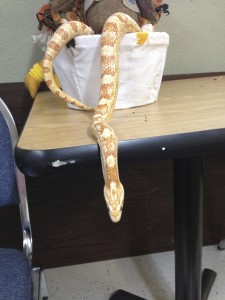
Commonly known as Rat Snakes, they are found in the southeastern part of the United States…from Texas to Florida. These constrictors are related to the Gopher Snakes.
Blue-Tongue Skink
Found only in Australia, these amazing lizards live in a variety of habitats ranging from deserts to forests and mountainous areas. Their bright blue tongue is used in defensive postures.
European Legless Lizard
The largest member of the legless lizard family, the European Legless Lizard is found in southeastern Europe and moves by wiggling its body. They burrow underground and are often called glass lizards because they have the ability to drop their tails.
Bearded Dragon
These lizards get their name from their “beard,” an expandable throat pouch with spikey scales. Not being finicky eaters, they will consume large amounts of plants and insects. They come from Australia and are popular pets for the young reptile enthusiast.
Leopard Gecko
Leopard Geckoes have sweet personalities and are popular as pets. You can see through their heads! Geckoes are great nocturnal hunters…feasting on bugs
Box Turtle
A land dwelling turtle that is found in the United States, box turtles have a hinge on the bottom of their shell which allows them to completely withdraw their legs, tail, head and neck within the shell for protection from predators.
NOTE AVAILABLE AT THIS TIME
NOTE AVAILABLE AT THIS TIME
Crested Gecko
At one time these geckoes were thought to be extinct until they were rediscovered in 1994. These tree-dwelling lizards are only found in the rainforest canopies of New Caledonia.
Russian Tortoise
Known by many names, this small tortoise is found in southern Russia to Afghanistan. Russian tortoises prefers dry open landscapes and they can live over 100 years!
Green Iguana
Found from Central to South America, green iguanas can weigh up to 18 pounds and reach a length of 5-7 feet. They are mainly herbivorous feasting on leaves, flowers and fruit. Iguanas are excellent swimmers and tree climbers.
Leopard Tortoise
The African Leopard tortoise is the 4th largest tortoise in the world and they can reach lengths of 2 feet and weigh over 80 pounds. These tortoises are found in sub-Saharan Africa grassland habitats.
Sulcata Tortoise
The Sulcata Tortoise gets its name from the thorny spurs on its back legs. They are found in deserts and dry savannahs of Africa and they are the 3rd largest species of tortoise in the world! They can reach over 2 feet in length and weigh 150 pounds.
NOTE: AVAILABLE FOR SOME MOBILE EVENTS.
NOT AVAILABLE FOR MOBILE PARTIES
NOTE: AVAILABLE FOR SOME MOBILE EVENTS.
NOT AVAILABLE FOR MOBILE PARTIES
The Amphibians
European Toad
Like all toads, the European toad has rough skin. They have keen eyesight and are efficient hunters, rarely missing a prey item. Their diet consists primarily of invertebrates, including insects, spiders, and worms. It is distributed throughout mainland Europe, Britain, Scandinavia, western-central Asia, and northwestern Africa. NOT AVAILABLE AT THIS TIME.
Painted Frog
This small amphibian comes from Malaysia. Also known as a Chubby Frog, they blow themselves up like a balloon to keep from being eaten.
White’s Tree Frog
Native to Australia and New Guinea, this frog can live up to 16 years in captivity. It is sometimes called a Dumpy Tree Frog.
Tiger Salamanders
Once commonly found throughout North America, these amphibians are nocturnal. They consume a lot of insects in a single night.
The Invertebrates
Hissing Cockroaches
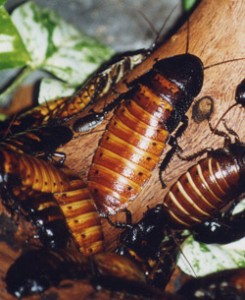
These insects perform the most important job in nature…they recycle! Their diet consists of dead leaves that they turn into soil. To avoid being eaten, they hiss like a snake and wear a ‘snake-like’ mask over their head. They are only found on the island of Madagascar.
Millipede
There is no animal in the world with more legs than a millipede. They have two pairs of legs on each segment…over 200 in all! They eat dead leaves and make soil. Don
Chilean Rose-haired Tarantula
More bugs are consumed by spiders than any other type of predator. The Rosy Hair Tarantula comes from the dry regions of Chile. Their prickly hair makes them unpleasant to eat. !!!
The Birds
Our feathered friends only perform in an indoor venue!
Laughing Kookaburra
The laughing kookaburra is well known both as a symbol of Australia’s birdlife and as the inspirational “merry, merry king of the bush” from the children’s song. Native to the eucalyptus forests of eastern Australia. Its beak can reach 4 inches (10 centimeters) long and is used to snatch a variety of invertebrates and small vertebrates, including the occasional snake. NOTE: “CHATTY KATHY” IS NOT AVAILABLE FOR MOBILE PARTIES.
Birmingham Roller Pigeon
The Mammals
Chinchilla
Chinchillas live high in the Andes mountain of South America at elevations above 18,000 feet. Their thick fur makes them the softest animals in the world. Because of this, our chinchillas cannot be used for programs in the summer months. Our chinchillas will be on vacation for the spring and summer – Look for their return this fall!