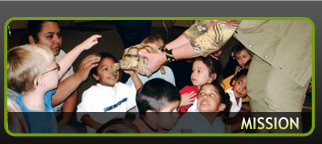
Nature’s Critters has worked with students of ALL ages (toddlers to senior citizens). Our unique way of teaching people to view nature in an appreciative way has influenced many to value and treasure wildlife. School programs encompass a variety of topics ranging from adaptations to classifications. We use interaction with the students and, of course, our live animal friends in programs lasting between 45 to 60 minutes. Programs are age appropriate and can be designed to suit your school’s particular needs. Please keep in mind groups over 40 people will be in an assembly style presentation. Children in the assembly will be able to touch one or two animals after the program.
“Hidden In Plain Sight”
Kids will meet animals which use camouflage or mimicry to ‘disappear’ right before our eyes. A variety of animals include amphibians (frogs, toads and salamanders), reptiles (snakes, lizards and turtles), birds (parrots), mammals and bugs.
“Radical Reptiles”
Are reptiles really all that different from us? The similarities and differences between us and our scaly relatives will be explored. Live reptiles (snakes, lizards and turtles) will dispel the myths and misconceptions we are taught about these gentle animals.
“One World-One Family”
We cannot exist without other living things. This program looks at all the ways people are dependent on the natural world…decomposers, seed dispersers, pollinators and predators. Compassion and respect are emphasized as kids touch a variety of animals (amphibians, reptiles, birds, mammals and bugs).
“Animals From Around The World”
A geographical journey from the classroom to the continents of Europe, Africa, Asia, Australia, South America and North America. Kids will meet live animals (invertebrates, reptiles, amphibians, birds and mammals) representing different parts of the world and learn what special contributions these animals make.
“It’s A Jungle Out There”
Look at life in a tropical rainforest. From the forest floor decomposers (bugs) to the highest canopy dwellers (parrots), discover how this complex ecosystem works. Visit these ecologically rich regions through a visit with some live animals from the different layers of the forest. A food chain is explored, working its way through the different layers of the forest.
“Going, Going…Gone!”
Why are animals disappearing? How many species are we losing each year? What does threatened, endangered and extinct mean? This program uses live animals (python, parrot, chinchilla, frogs, iguana and bugs) to illustrate how factors such as population growth, habitat destruction, pollution and lifestyle choices impact wildlife.
“Animal Classifications”
From the simplest animals (worms, millipedes and insects) to the most complex (amphibians, reptiles, birds and mammals), students learn how each organism specializes in carving out a niche in a complex world. Kids will understand how and why animals are classified into different groups–what they have in common and how they differ.